

NASA's Artemis I mission successfully returns to Earth after historic lunar journey
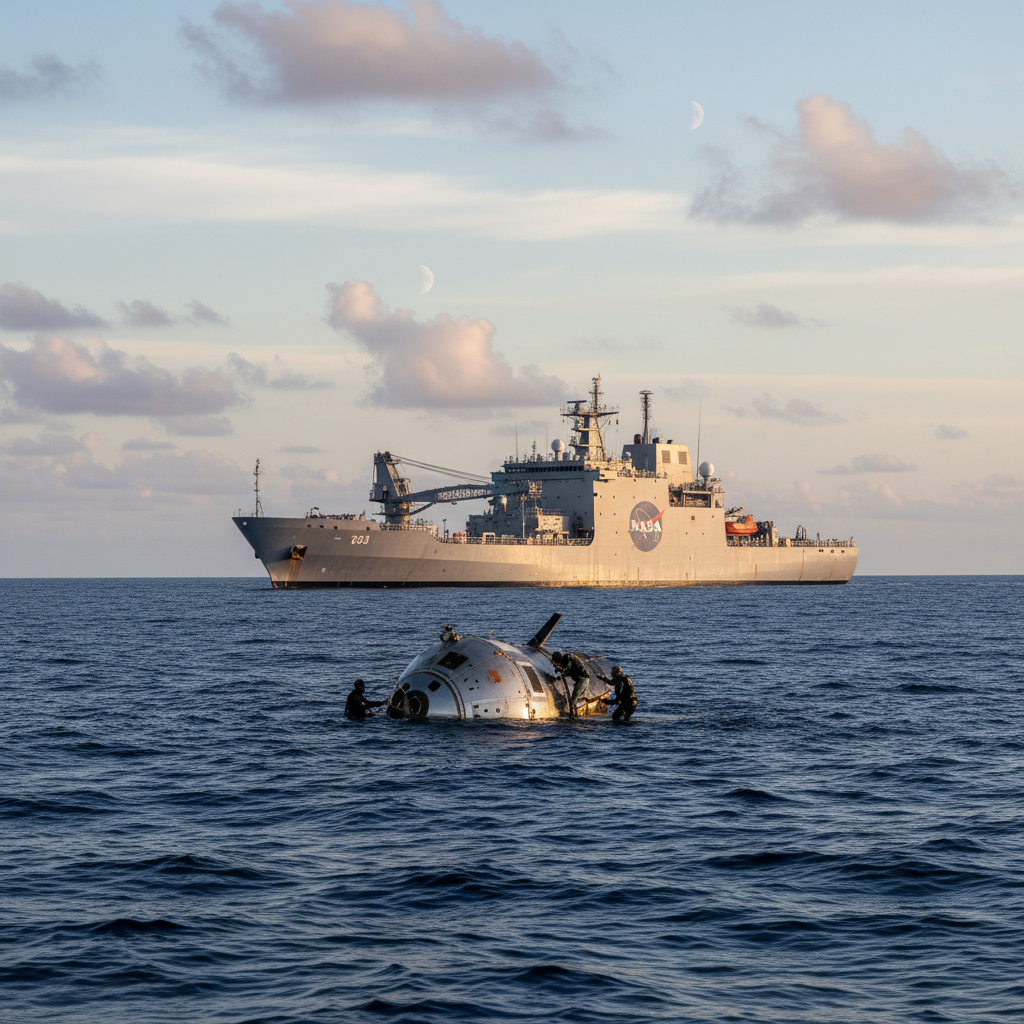
**Headline: A New Era of Lunar Exploration: Orion’s Triumphant Return Marks the Conclusion of Artemis I**
The journey to re-establish a human presence on the Moon has cleared its most significant hurdle yet. NASA’s Orion spacecraft successfully concluded the Artemis I mission recently, executing a precision splashdown in the Pacific Ocean after a historic 25.5-day odyssey that took it farther into deep space than any vessel designed for human transport has ever ventured.
This uncrewed flight served as a grueling stress test for NASA’s most advanced systems. Throughout the 1.4 million-mile trek, the Space Launch System (SLS) rocket and the Orion capsule performed exceptionally, proving their readiness for the harsh conditions of translunar travel. A critical highlight of the mission’s conclusion was the spacecraft’s re-entry into Earth’s atmosphere; Orion endured scorching temperatures of approximately 5,000 degrees Fahrenheit—roughly half the heat of the sun—while traveling at speeds of 25,000 mph to verify the integrity of its revolutionary heat shield.
NASA Administrator Bill Nelson characterized the successful recovery as a "defining day," noting that the achievement transitions the agency from a period of testing into a new chapter of active exploration. With the data gathered from this flight, the path is now paved for Artemis II, which will carry a crew of astronauts around the Moon, and eventually Artemis III, which aims to land the first woman and first person of color on the lunar surface.
The mission’s success confirms that the foundational technology for long-term deep-space habitation is not just functional, but flight-ready. As the Orion capsule returns to the Kennedy Space Center for detailed analysis, the global scientific community celebrates a pivotal step toward making the Moon a gateway for future voyages to Mars.
***
Originally published by Australian Securities Exchange
Columnist
Australian Securities Exchange